keratoconus
Keratoconus Athens Protocol
The Athens Protocol involves performing topography-guided laser (PRK) and cross-linking (CXL) in the same session for keratoconus treatment. It both corrects the cornea and halts the progression of the disease.
Prof. Dr. Efekan Coşkunseven
Ophthalmology · Istanbul
{ AI · preliminary guidance }
onlineLet's talk about keratoconus

AI responses do not replace a medical diagnosis.
Quick Answer
The Athens Protocol is a combined keratoconus treatment that corrects the corneal surface with topography-guided laser and strengthens the corneal structure with cross-linking (CXL) in the same session. It reduces irregular astigmatism and halts progression.
Contents5 sections
What Is the Athens Protocol?
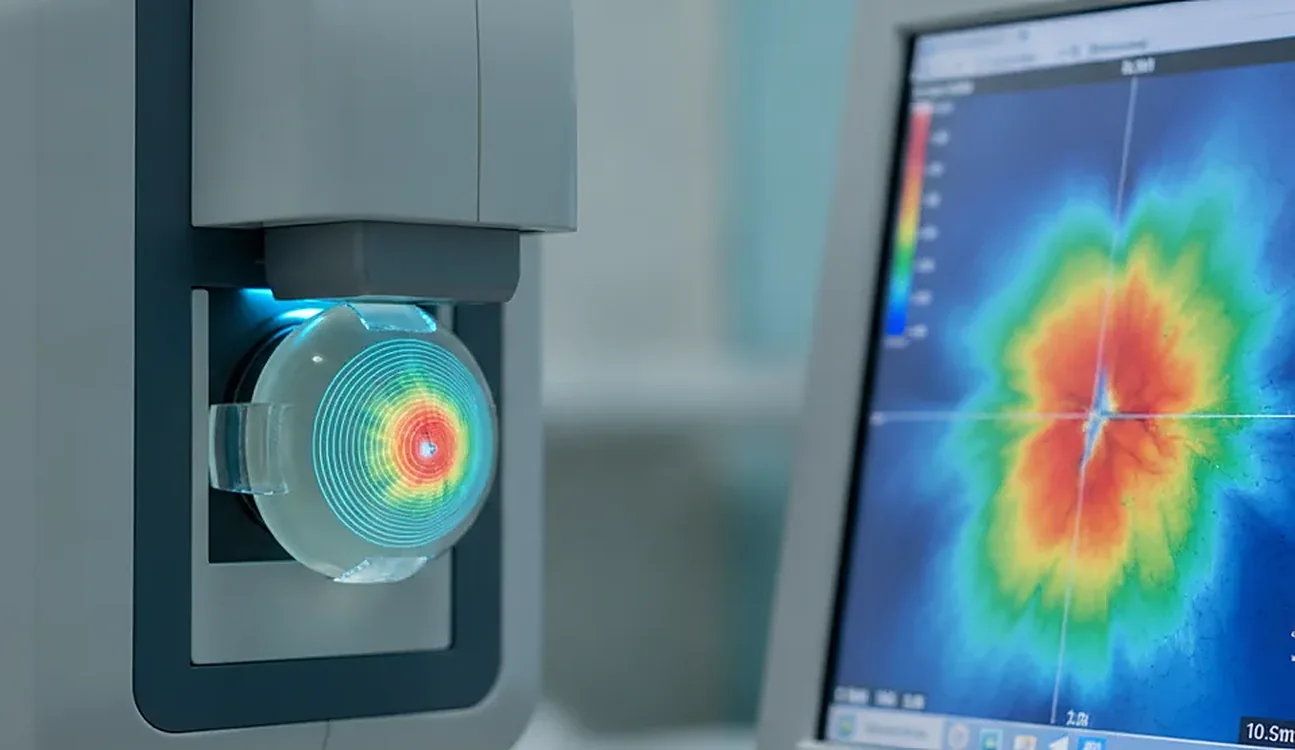
The Athens Protocol involves performing topography-guided laser (PRK) together with cross-linking in the same session for the treatment of keratoconus. This method is a combined approach aimed at halting the progression of the disease and correcting the corneal surface.
What Does It Do?
The procedure takes place in two stages:
- Topography-guided laser: Surface correction is performed according to the corneal map, reducing irregular astigmatism.
- Cross-Linking (CXL): The corneal structure is strengthened with UV-A light, halting progression.
As a result, it both corrects the cornea and halts the progression of the disease.
Who Is It Suitable For?
- Early and moderate-stage keratoconus (Stage 1–2, selected Stage 3)
- Patients with sufficient corneal thickness
- Patients with high irregular astigmatism
- Patients who cannot see clearly with glasses
Procedure Process
The procedure takes approximately 45–60 minutes:
- Removal of the epithelial layer
- Application of topography-guided laser
- Instillation of riboflavin drops
- UV-A light (approximately 30 minutes)
- Fitting of a bandage contact lens
Results
Within the first 3–6 months:
- Irregular astigmatism decreases
- Night vision improves
- Double/shadowed vision decreases significantly
- Glasses prescription may decrease
- An improvement of at least 1–3 lines of vision may be observed
The results of any surgical or invasive procedure may vary from person to person.
Last updated:
2 questions
Frequently Asked Questions
Short answers to the questions patients ask most about this treatment. Your personal situation is assessed during the examination.
Didn't find your question?
Send us your question directly and our team will get back to you.
-
01 Who is the Athens Protocol suitable for?
It is suitable for early and moderate-stage keratoconus (Stage 1–2, selected Stage 3), patients with sufficient corneal thickness, those with high irregular astigmatism, and patients who cannot see clearly with glasses.
-
02 How is the procedure performed?
The epithelial layer is removed, topography-guided laser is applied, riboflavin drops are instilled, and UV-A light is administered for approximately 30 minutes; a bandage contact lens is then fitted. The procedure takes approximately 45–60 minutes.
Didn't find your question?
Send us your question directly and our team will get back to you.
Related topics
Treatments often evaluated together
-
Keratoconus Treatment
Keratoconus is a progressive eye disease in which the cornea gradually thins and bulges forward into a cone shape over time. Early diagnosis and the choice of an appropriate method (crosslinking/CXL, CAIRS, and intracorneal ring segments) are critical for controlling the disease.
-
Corneal Collagen Cross-Linking (CXL / Cross-Linking)
CXL is a method used in keratoconus treatment to increase the structural strength of the cornea in order to halt the progression of the disease. It was first applied in Turkey in 2004 by Prof. Dr. Efekan Coşkunseven.
-
Topolaser (Topography-Guided Excimer Laser)
Topolaser is an excimer laser treatment planned individually based on the cornea's surface map. Its goal is to correct surface irregularities in the cornea and improve visual quality. It is generally applied together with CXL for stabilization.
Clinic

Book an Appointment
Your information reaches Prof. Dr. Efekan Coşkunseven's clinic. A response is made within 24 hours.