keratoconus
Implantable Contact Lens (ICL)
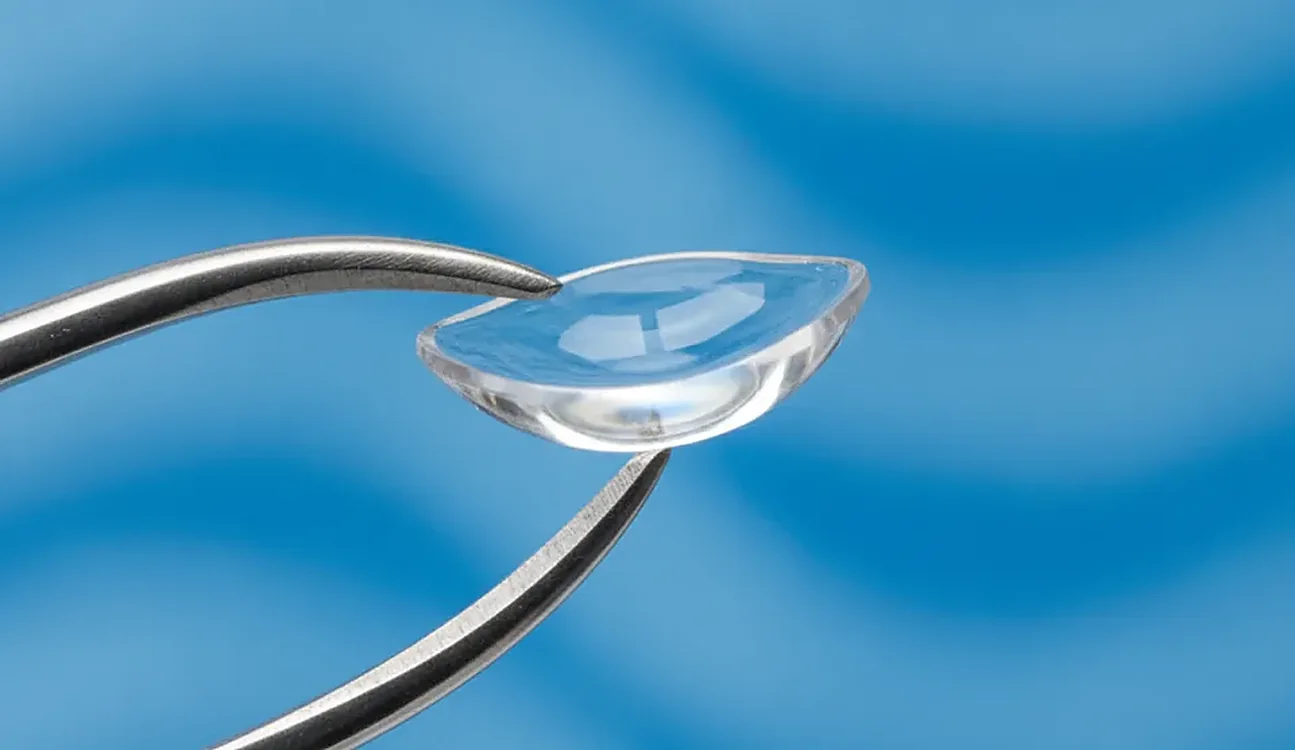
ICL is a special lens placed inside the eye; it corrects high myopia and astigmatism without intervening in the corneal tissue. In keratoconus patients, it can be applied to improve visual quality once the disease has stabilized.

Prof. Dr. Efekan Coşkunseven
Ophthalmology · Istanbul
{ AI · preliminary guidance }
onlineLet's talk about keratoconus

AI responses do not replace a medical diagnosis.
Quick Answer
The implantable contact lens (ICL) corrects high myopia and astigmatism with a thin lens placed inside the eye, without touching the cornea. It is reversible and not felt; in keratoconus, it improves visual quality once the disease has stopped progressing, in patients who are not suitable candidates for laser treatment.
Contents6 sections
What Is the Implantable Contact Lens (ICL)?
ICL is an advanced eye treatment method used for high myopia, astigmatism, and certain special conditions. A specially designed thin lens is placed inside the eye, allowing light to be focused properly onto the retina. It works without disrupting the corneal tissue and can be removed if necessary.
ICL Treatment in Keratoconus Patients
In keratoconus patients, ICL can be applied to improve visual quality in patients who have keratoconus together with high myopia or astigmatism. However, it is not a treatment that eliminates keratoconus.
Conditions for eligibility:
- The progression of the disease must have stopped
- Adequate vision cannot be achieved with glasses/contact lenses
- Patients not suitable for laser treatment
- Presence of high myopia/astigmatism
How Is Suitability Evaluated?
Suitability is assessed following a detailed eye examination and advanced technological measurements: corneal topography, Pentacam corneal analysis, intraocular pressure measurement, retinal examination, and intraocular distance measurements.
How Is the Surgery Performed?
It is performed under local anesthesia administered with drops. The procedure takes 10–15 minutes. The lens is inserted through a small incision at the edge of the cornea and fixed inside the eye. Patients can return to daily life the same day.
Advantages
- Corneal tissue is preserved
- High visual quality can be achieved
- It is a reversible method
- Not felt inside the eye
- Night vision may improve
- An alternative to laser treatment
Differences Between ICL and Laser Treatment
- Corneal intervention: Laser reshapes tissue in the cornea; ICL does not involve any intervention to the cornea.
- Permanence: Laser cannot be reversed; ICL can be removed.
- Patient suitability: Laser requires a suitable corneal structure; ICL may be preferred in thin corneas.
The results of any surgical or invasive procedure may vary from person to person.
Last updated:
8 questions
Frequently Asked Questions
Short answers to the questions patients ask most about this treatment. Your personal situation is assessed during the examination.
Didn't find your question?
Send us your question directly and our team will get back to you.
-
01 Can keratoconus patients undergo ICL surgery?
It can be applied in some patients. It requires that the progression of the disease has stopped and that the structure of the eye is suitable.
-
02 Does ICL fully treat keratoconus?
No. It improves visual quality; it does not eliminate the disease.
-
03 Is the ICL lens felt inside the eye?
No. It is not visible from the outside and is not felt by the patient.
-
04 How long does ICL surgery take?
Approximately 10–15 minutes.
-
05 Is the ICL lens permanent?
It can remain permanently; however, it can be removed or replaced if necessary. It is a reversible method.
-
06 Is ICL surgery safe?
Yes, the method has been used for many years, and its risks are assessed with the physician. Rarely, increased intraocular pressure, light halos, or lens positioning issues may be seen.
-
07 Can keratoconus patients undergo laser surgery?
In most cases, no. Because the corneal structure is weak, alternatives such as ICL may be preferred.
-
08 Is there an age limit for ICL?
It is generally evaluated in patients over 18 years of age whose eye prescription is stable.
Didn't find your question?
Send us your question directly and our team will get back to you.
Related topics
Treatments often evaluated together
-
Keratoconus Treatment
Keratoconus is a progressive eye disease in which the cornea gradually thins and bulges forward into a cone shape over time. Early diagnosis and the choice of an appropriate method (crosslinking/CXL, CAIRS, and intracorneal ring segments) are critical for controlling the disease.
-
High Myopia Treatments (ICL & Phakic Lens)
High myopia (above -6.00 diopters) can be corrected with personalized methods such as laser, phakic intraocular lenses (ICL), refractive lens exchange, and corneal rings. High myopia also requires regular follow-up for retinal and overall eye health.
-
Vision Rehabilitation: Specialty Contact Lenses
After the progression of keratoconus has been halted, specialty contact lenses are used to improve visual quality. These lenses mask corneal irregularities to provide sharp vision (RGP, scleral, and hybrid lenses).
Clinic



Book an Appointment
Your information reaches Prof. Dr. Efekan Coşkunseven's clinic. A response is made within 24 hours.