






+200,000 Operations Performed
Prof. Dr. Efekan Coşkunseven Laser Refractive Surgery
Personalized and Internationally Referenced Approach to Refractive Errors
Firsts in Turkey and the World
He is a globally recognized authority in keratoconus, whose treatment protocols have informed the training of numerous physicians worldwide.
Laser Refractive Surgery
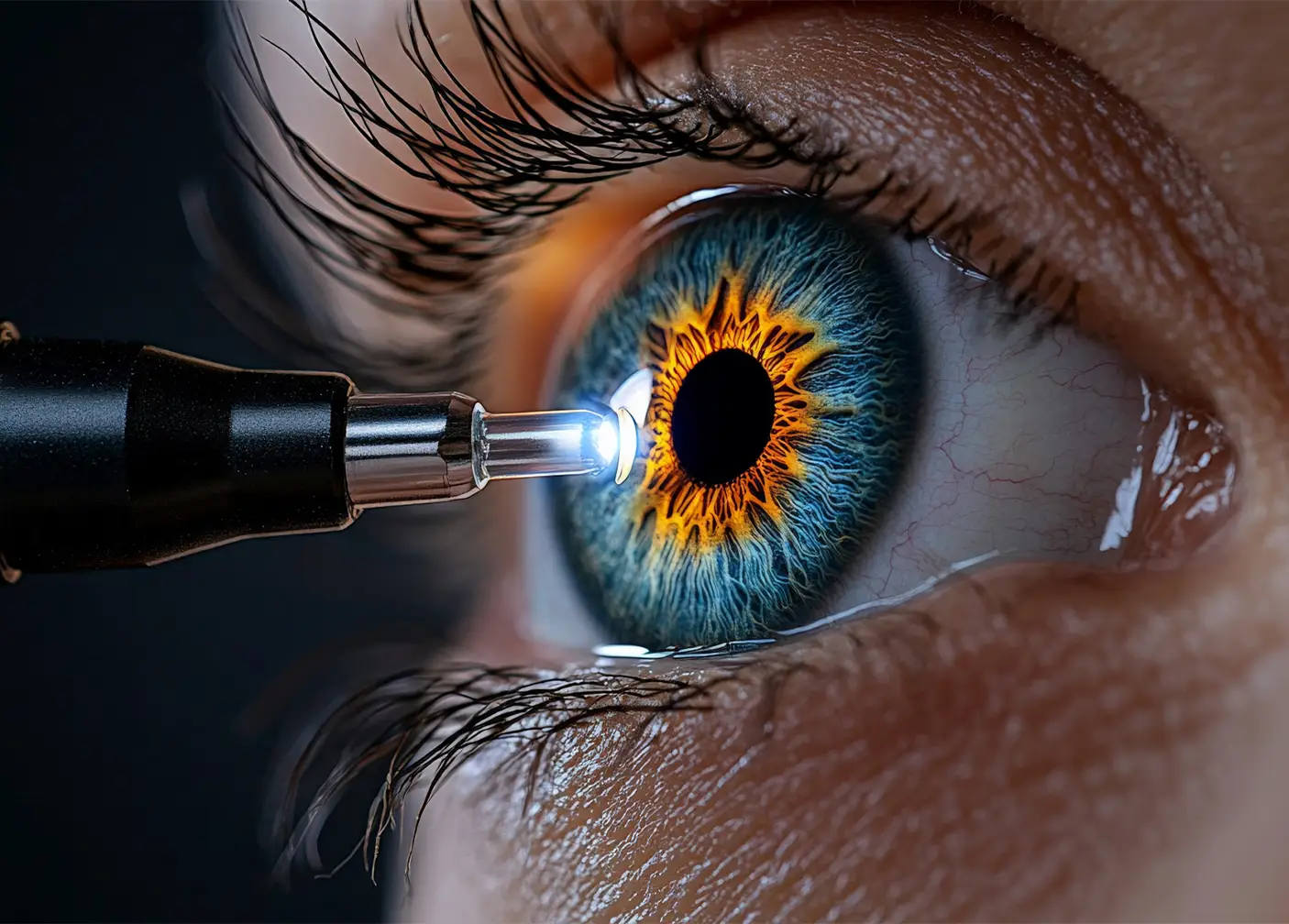
Laser refractive surgery is a surgical treatment used to correct refractive errors such as myopia, hyperopia, and astigmatism. The procedure works by reshaping the cornea using a laser, which allows light to focus more accurately on the retina and corrects the underlying vision impairment.
Refractive Error: What You Need to Know
A refractive error is a vision problem that occurs when the eye cannot bend light correctly. These conditions typically result from abnormalities in the curvature of the cornea or the length of the eye. The most common refractive errors are myopia, hyperopia, and astigmatism.
Myopia (Nearsightedness): Myopia causes distant objects to appear blurry. It occurs when the eye is too long or the cornea is too steeply curved, causing light to focus in front of the retina rather than directly on it.
Hyperopia (Farsightedness): In hyperopia, the eye may be too short or the cornea too flat, causing light to focus behind the retina. This makes it difficult to see nearby objects clearly.
Astigmatism: Astigmatism occurs when the cornea or lens has an irregular curvature, causing blurred vision at both near and far distances.
Refractive errors can affect daily life, but a range of treatment options is available to correct them.
Laser Refractive Surgery: An Overview
Laser refractive surgery is a surgical treatment used to correct refractive errors such as myopia, hyperopia, and astigmatism. The procedure works by reshaping the cornea — the clear front surface of the eye — using a laser, allowing light to focus more accurately on the retina and thereby improving vision.
The goal of laser eye surgery is to reduce or eliminate your dependence on glasses or contact lenses, improving your overall quality of life. Several distinct laser techniques — including LASIK, PRK, and lenticule extraction surgery (SMILE) — allow patients to achieve rapid, effective results.
LASIK (Laser-Assisted In Situ Keratomileusis): One of the most widely performed laser eye surgery techniques, LASIK involves creating a thin flap on the surface of the cornea. The underlying corneal tissue is then reshaped with a laser to correct your refractive error and improve focusing ability. The flap is repositioned at the end of the procedure and heals naturally.
PRK (Photorefractive Keratectomy): In PRK, the corneal surface is reshaped directly with a laser. During the procedure, the outermost corneal layer (the epithelium) is removed — either manually or using a laser in the No Touch technique — after which the deeper corneal tissue is reshaped. The epithelium regenerates on its own over the following days.
Lenticule Extraction Surgery (SMILE — Small Incision Lenticule Extraction): SMILE is a more recent technique compared to LASIK and PRK. A small disc of corneal tissue (the lenticule) is created within the cornea using a laser and then removed through a small incision. This approach is primarily used to treat myopia.
Who Is a Candidate?
Individuals with vision problems caused by refractive errors, good overall eye health, and a stable prescription may be suitable candidates for laser eye surgery.
Efekan Coşkunseven — Refractive Surgery Experience
Assoc. Prof. Dr. Efekan Coşkunseven has been involved in refractive surgery since 1996 and served as Director of the Refractive Surgery Division at Dünya Göz Hospital from 2003 to 2023. Over the course of his career, he has performed more than 40,000 LASIK and more than 120,000 iLASIK procedures.
Advanced Surgical Training (2000)
Completed advanced refractive surgery training under Prof. Ioannis Pallikaris (University of Crete), widely regarded as one of the founding figures of laser eye surgery.
First WaveLight Excimer Laser in Turkey (2001)
Performed the first LASIK procedure in Turkey using the WaveLight excimer laser platform.
First IntraLase Laser in Turkey (2003)
Became the first surgeon in Turkey to perform LASIK using the IntraLase femtosecond laser.
International Instructor (2004)
Selected by Johnson & Johnson (AMO, California, USA) as an international IntraLase Proctor (certified instructor). He remains one of a small number of credentialed IntraLase instructors worldwide.
First Epi-LASIK and CK Procedures in Turkey (2003–2004)
Performed the first Epi-LASIK procedure in Turkey (2003) and the first Conductive Keratoplasty (CK) procedure in Turkey (2004).
PresbyLASIK and Corneal Inlay Pioneer (2006)
A pioneer in Turkey for PresbyLASIK (laser treatment for near vision correction) and corneal inlay implantation (KAMRA, 2006).
Pioneering Laser Applications
Introduced wavefront-guided and topography-guided LASIK (TopoLASIK), as well as Q-value LASIK, to Turkey for the first time.
Firsts with Innovative Devices
The first surgeon in Turkey to perform multiple laser procedures using the Schwind microkeratome, Moria M2, and Hansatome XP platforms.
LASIK, PRK, and SMILE Procedures
Each laser surgical technique offers different advantages depending on the patient's needs and eye anatomy. Comparing these techniques can help you understand which approach may be most appropriate for you.
|
Technique |
Advantages |
Disadvantages |
|---|---|---|
|
LASIK |
Fast recovery, minimal discomfort |
Not suitable when the cornea is too thin. |
|
PRK |
Suitable for patients with thin corneas |
Longer recovery period; more discomfort and pain in the initial days. |
|
SMILE |
Smaller incision, lower risk of dry eye |
More limited indications; applicable only within certain ranges of myopia. |
Which of these techniques is right for you will become clear following a detailed examination by your ophthalmologist.
Recommendation
Each laser technique is selected based on the individual's corneal anatomy, the type of refractive error, and their personal needs.
Suitability for Laser Treatment
Not every patient is a suitable candidate for laser eye surgery. There are several criteria to consider before laser treatment is recommended:
Age: Laser surgery is generally appropriate for individuals over 18 whose prescription has remained stable for at least one year. A stable prescription helps ensure that the results of treatment are long-lasting.
Eye Health: The structure of your eye and your overall ocular health are critical factors in determining suitability for laser surgery.
Comprehensive Eye Examination: A detailed eye examination is performed to assess whether you are a suitable candidate for laser eye surgery. This evaluation includes your eye structure, corneal thickness, intraocular pressure, and the presence of dry eye. Your exact prescription is also confirmed at this stage.
Topography and Other Tests: A corneal topography test — which maps the surface of the cornea — along with dilated eye examinations and other diagnostic tests are carried out as part of the assessment.
Contact Lens Use: If you wear contact lenses, you may need to stop wearing them for a period before surgery. This allows the cornea to return to its natural shape — typically one week for soft lenses, and longer for rigid lenses.
Systemic Health: Conditions such as diabetes, autoimmune disorders, or active eye infections can increase the risks associated with laser surgery. Your overall health is an important factor in determining whether you are a suitable candidate for treatment.
Pregnancy and Breastfeeding: Laser treatment is not recommended during pregnancy or breastfeeding, as hormonal changes during these periods can cause temporary fluctuations in your prescription.
Every individual's eyes are unique. A thorough examination by your doctor is the only reliable way to determine whether laser treatment is right for you.
Who Is a Suitable Candidate?
Individuals with healthy eye structure, a stable prescription, and good general health may be candidates for laser surgery.
Surgical Procedure and Post-Operative Recovery
Laser refractive surgery is typically a brief outpatient procedure performed without any pain. The total procedure time for both eyes ranges from 15 to 20 minutes. After the procedure, vision begins to improve rapidly.
The Surgical Process
Preparation: Before surgery, anaesthetic eye drops are applied to your eyes. These drops ensure you feel no discomfort during the procedure. You will be fully awake throughout, but your eyes will be numbed.
Sterile Environment: The area around your eye is prepared under sterile conditions, and your head is positioned comfortably and correctly.
Procedure: The specific steps vary depending on the type of surgery. The procedure generally takes 10 to 15 minutes, although the laser itself is active for a much shorter time — typically between 10 to 15 seconds and one minute.
Recovery
Early Recovery: With LASIK, clear vision can typically be achieved within one day; with PRK and SMILE, this may take a few days. During PRK, some blurring may persist for several weeks while the epithelium heals.
The First Few Weeks: Follow-up examinations are scheduled during the recovery period, and regular use of eye drops continues. During the first week after surgery, you are advised to avoid rubbing your eyes and to stay away from dusty or dirty environments.
Possible Complications: Although laser surgery is generally a safe procedure, certain complications can occur, including:
-
Dry eyes
-
Halos around lights at night
-
Risk of eye infection
-
Mild regression of the refractive correction
Your doctor will provide guidance on post-operative eye drops and protective measures to support your recovery.
Our Recommendation
If you have undergone laser surgery for a refractive vision disorder, it is important to follow the recommended post-operative recovery guidelines carefully.
Risks and Success Rate of Laser Surgery
Laser refractive surgery is a safe and effective procedure chosen by millions of people worldwide. As with any surgical intervention, however, certain risks and side effects exist.
Success Rates:
The success rate of laser refractive surgery is very high, and most patients achieve clear vision. Procedures such as LASIK, PRK, and SMILE eliminate the need for glasses or contact lenses in the vast majority of patients. Clear vision is typically achieved within a few days of treatment. Outcomes can vary depending on your eye's anatomy, corneal thickness, and pre-operative prescription. Lower prescriptions tend to yield higher success rates, while higher prescriptions may require a minor residual correction. Overall, the large majority of patients who undergo laser surgery are satisfied with their results.
Risks:
Dry Eye: The most frequently encountered complication following laser surgery is dry eye. This is generally temporary and can be managed with lubricating eye drops.
Nighttime Glare and Halos: Some patients may experience visual disturbances such as halos or glare around lights when driving at night or in brightly lit environments.
Regression: Although uncommon, the refractive correction achieved by laser surgery can partially regress over the years in some patients. In such cases, an additional treatment may be necessary.
These risks are rare and, in most cases, temporary. It is important to discuss the risks and expected success rates in detail with your doctor before proceeding with surgery.
Who Is a Suitable Candidate?
Laser surgery is a suitable option for individuals who wish to live without glasses or contact lenses and who have appropriate ocular health.
Frequently Asked Questions
For More Information, Please Get in Touch
Error: Contact form not found.